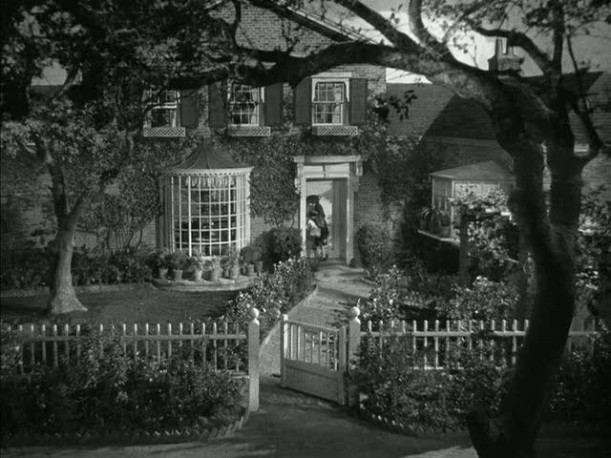
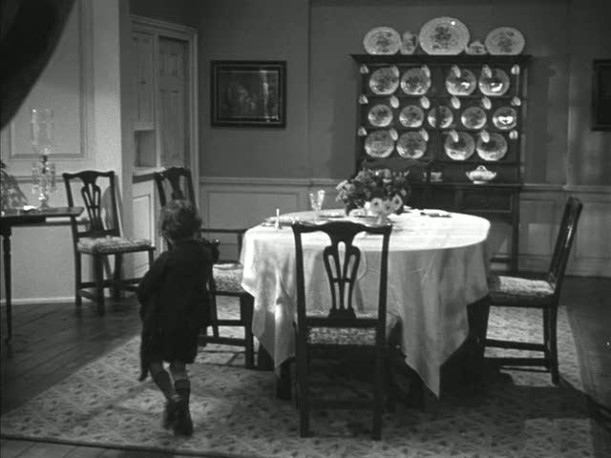
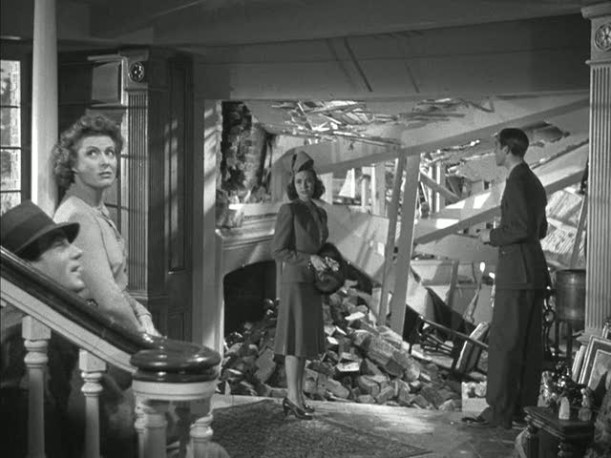
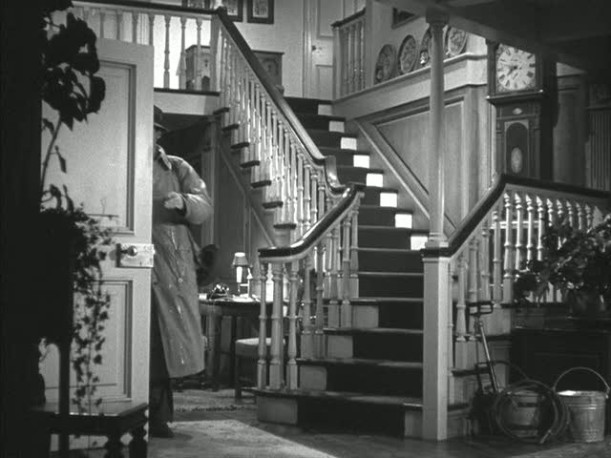
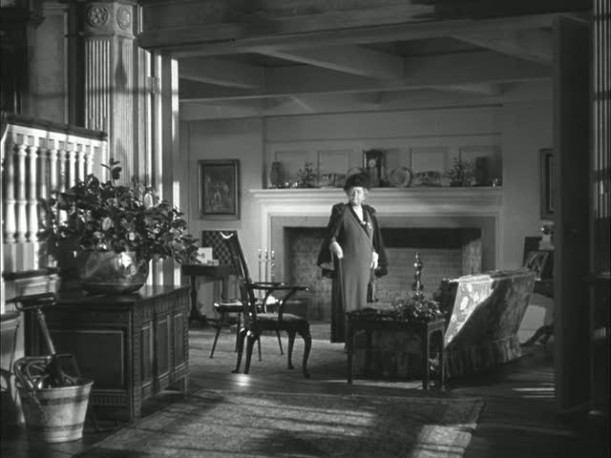
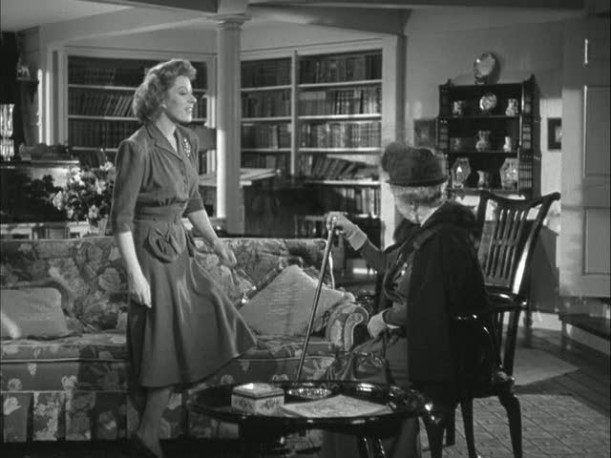
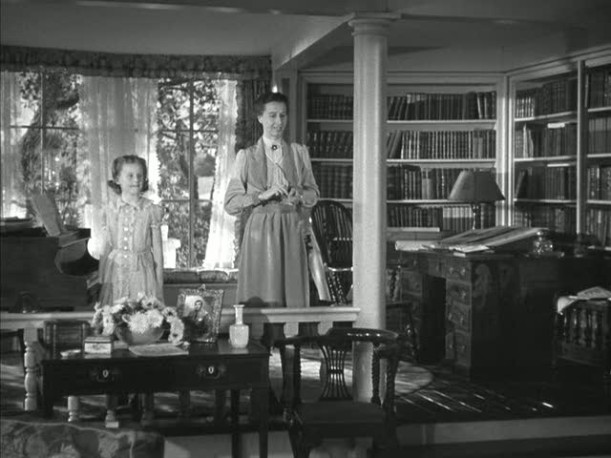
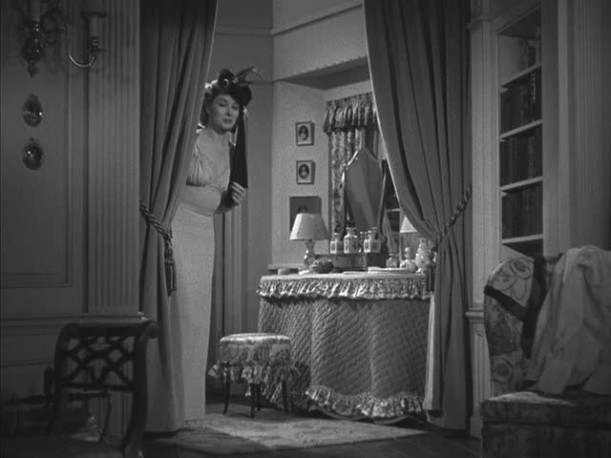
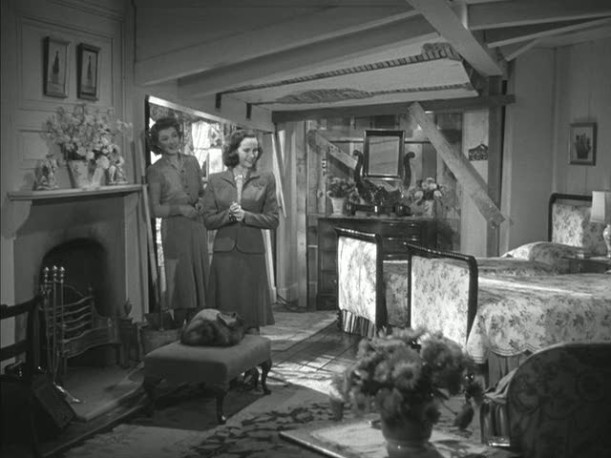
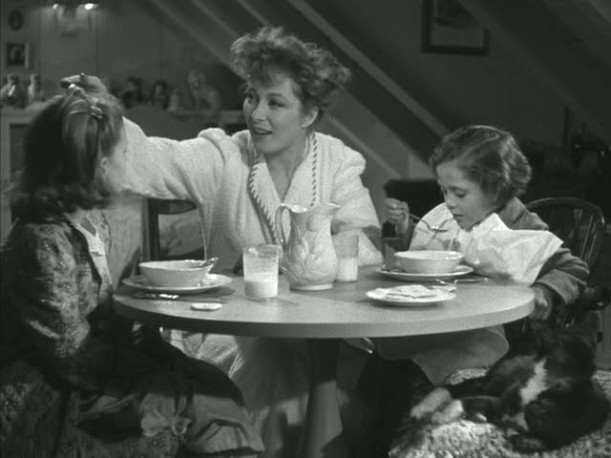
“Last night I dreamt I went to Manderley again.” Who could forget the opening line from Rebecca? It lets us know that this is a story about a house, and it’s no ordinary pile of bricks. It’s Maxim de Winter’s ancestral estate on the Cornish coast. But even though Manderley looks like a dream home, it turns out to be a nightmare for Maxim and his new bride.
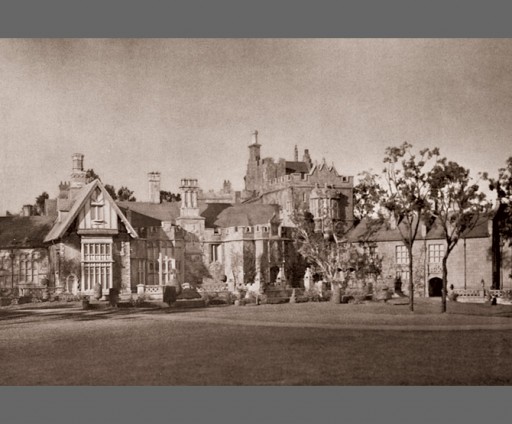
Despite the fact that the story takes place in England, and most of the actors are British, the movie was filmed entirely in California.
“The one exterior view of the house was actually a miniature built on a table and then blown up to appear as an imposing mansion.” -Architectural Digest
Everything else appears to have been created on soundstages and with painted backgrounds.

Rebecca was Alfred Hitchcock’s first film in the U.S, made in 1939. He wanted access to Hollywood stars, better equipment, etc. He later brought Du Maurier’s novels Jamaica Innand The Birds to the big screen, as well.

In this promotional photo from the film, the new Mrs. de Winter is introduced to her household staff–and is a little intimidated by it all:

Joan Fontaine’s character’s name is never revealed in the novel or the film. She was referred to as “I” in the script.

The novel was written by Daphne Du Maurier. David O. Selznick acquired the rights to it for $50,000.
A little trivia: Did you know that Selznick added the “O” to his name because he thought it looked good? Totally made it up. In Hitchcock’s later film North by Northwest, Cary Grant’s character is named Roger O. Thornhill. When someone asks him what the “O” stands for, he says, “Nothing!” (You can see my post about that movie here.)

Rebecca is a Gothic romance, in which the Cinderella fairytale goes wrong. Gothic romances usually feature great houses like this one, and they often meet a tragic end (thinkJane Eyre).

The house all decked out for the (ill-fated) costume ball:

“When the Academy Awards for 1940 were announced, at LA’s Biltmore Hotel on February 27 1941, it was a bittersweet night for Alfred Hitchcock. His first Hollywood production,Rebecca, took Best Picture, but he lost Best Director to John Ford for The Grapes of Wrath, the first in a career-long run of five nominations without taking a trophy.” –Telegraph

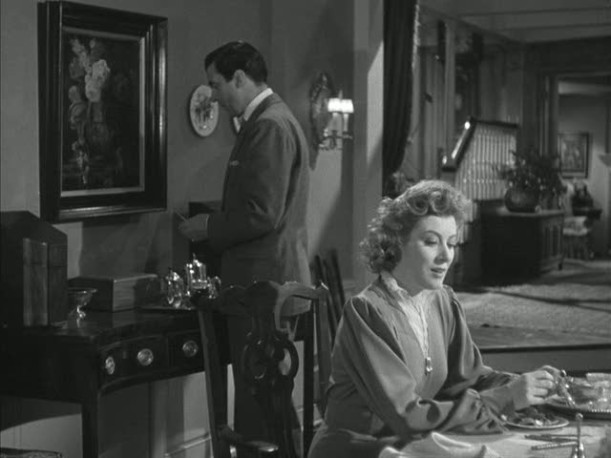
Movie critic Richard Schickel says that Hitchcock communicated in images that created the effect he wanted viewers to feel. For example, he shows how far apart the newlyweds are from each other–in more ways than one–when they eat at this vast and formal dining room table.

Later in his career, Hitchcock dismissed the idea that Rebecca was a classic, saying, “The fact is, the story lacks humor.”

The library:

Joan Fontaine’s real name was Joan de Beauvoir de Havilland. She didn’t use her real last name because her older sister, Olivia de Havilland, was already becoming well known as an actress. When Rebecca began filming, her sister had just finished playing Melanie inGone with the Wind (you can see my post about GWTW here).
Apparently Joan and Olivia were very competitive with each other. Hitchcock reportedly joked about how he wanted to sneak Olivia onto the set with Joan without her knowledge and film her (unhappy) reaction.

Mrs. De Winter’s new bedroom at Manderley which, as Mrs. Danvers points out, doesn’t have a view of the sea like Rebecca’s did:

Du Maurier’s grandfather was George Du Maurier, the author of the famous novelTrilby, which tells the tale of Svengali.


When I first saw Rebecca as a teenager, I was captivated by the idea of having a Morning Room like hers where I could go after breakfast to sit by the fire and catch up on my correspondence:

Rebecca’s writing desk with her distinctive monogram on everything:

The top of the grand staircase:

The upstairs hallway:

Walking to the wing where Rebecca’s room was:

Mrs. Danvers is more than happy to give the new Mrs. de Winter a tour of Rebecca’s wing:
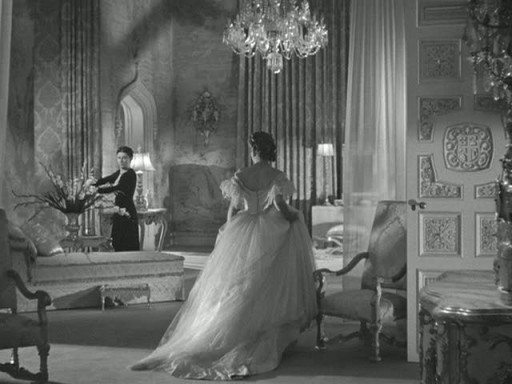
Censors worried about the homosexual undertones in the film when it came to Mrs. Danvers’ implied relationship with Rebecca (remember the scene where she fondles Rebecca’s lacy lingerie?). Because nothing was explicitly said or shown, however, they didn’t cut anything.
Daphne Du Maurier is believed to have had relationships with both men and women herself.
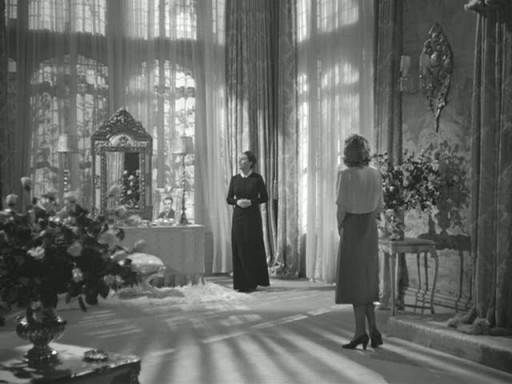

Mrs. Danvers has preserved all of Rebecca’s things exactly the way she left them–right down to the embroidered, monogrammed pillow on her bed. (So creepy!)

We get a peek inside the fabulous bathroom and dressing area:

George Sanders played Jack Favell, who was having an affair with Rebecca when she died and is determined to prove that her husband murdered her.
Sanders was married to both Zsa Zsa Gabor and her sister Magda (but not at the same time, natch). In 1972, Sanders famously killed himself after writing a suicide note that said, “Dear World, I am leaving because I am bored. I feel I have lived long enough. I am leaving you with your worries in this sweet cesspool. Good luck.”

*SPOILER ALERT! If you haven’t seen the movie or read the book, then the rest of this post might ruin the ending for you. You might want to go watch it first!
Rebecca’s Stone Cottage on the Beach:

Rebecca’s cottage was where she had trysts with men like Jack Favell. Everything appears to have remained exactly as it was the night she died–right down to her cigarette butts in the ashtray.

Selznick wanted the film to be as close to the novel as possible. There is a major departure, however. In the novel, Max de Winter shoots Rebecca. In the movie, Max says he struck her and when she fell, she hit her head and died.

When Laurence Olivier was cast as Max de Winter, he had just established himself in the U.S. as a romantic hero by playing Heathcliff in Wuthering Heights.
I always pictured Rebecca as a Vivien Leigh type, so it’s hard to believe that Leigh herself was up for the role of second Mrs. de Winter. She and Olivier were an item at the time and campaigned to get her cast alongside him. She had just finished playing Scarlett in Gone with the Wind.
The DVD features her screen test with Olivier, and she tried her best to play a “plain Jane,” but it just wasn’t very believable. Apparently the producers agreed. Fontaine–a relative newcomer at the time–was cast instead.

When Mrs. Danvers finds out the truth about Rebecca, she sets the house on fire. The final paragraph in the novel describes how the de Winters are driving home and slowly realize what has happened:
The road to Manderley lay ahead. There was no moon. The sky above our heads was inky black. But the sky on the horizon was not dark at all. It was shot with crimson, like a splash of blood. And the ashes blew towards us with the salt wind from the sea.

Author Daphne du Maurier was born in London in 1907 and began writing in her ’20s.Rebecca made her famous.
According to the Picture Show Man, Daphne du Maurier’s inspiration for Manderley was a 16th-century estate where she lived for awhile called Menabilly. Here’s a photo taken of her there (via the DVD Special Features):

Du Maurier grew up in a privileged world and knew how to write about it. Here she is in a photo taken at Menabilly with her three children. It was a place she loved:

I’ve read Rebecca and watched the movie countless times since I was a teenager, but I’ll never forget the first time I read it and how shocked I was by the various twists and turns in the story.
I also like the 1997 Masterpiece Theatre version with Charles Dance and Diana Rigg and have watched it several times. The sets are pretty amazing in it, too, and because it’s longer they were able to incorporate more scenes from the novel. Any other Rebecca fans out there? Do you have a favorite version?
Visit my TV/Movie Houses page for links to all the others I’ve featured, from Jane Eyre to North by Northwest.