Showing posts with label 1940s. Show all posts

Sunday, September 4, 2011

Mrs. Miniver’s House in World War II England


by HOOKEDONHOUSES on JUNE 27, 2011

Mrs. Miniver movie poster-Greer Garson

Igrew up watching old black and white movies with my mom. We’d go through the TV Guideat the beginning of each week and highlight all of the ones we wanted to watch so we wouldn’t miss anything good.

When I was in college I started doing research on some of my favorites and had the idea that I would someday write a behind-the-scenes book about them and my favorite film stars. I compiled files full of trivia and information I tracked down when I should have been doing my Algebra homework.

Okay, so I never wrote that book, but if you consider I have written a Movie Monday post every week like clockwork for the past 2 1/2 years, it kind of adds up to one, doesn’t it? To be honest, I don’t think I can keep it up.

The movie posts are hugely time consuming. So, starting in July, I’m going to give myself a break. I’ll still be covering TV and Movie sets, of course, but not every single week. I do have one for you today, though, and it’s a classic!

The 1942 movie Mrs. Miniver tells the story of a middle-class British family whose lives are disrupted by the start of World War II. It won 6 Oscars, including Best Picture, and was nominated for 6 more.

When the movie was filmed, Americans were still feeling neutral about the war in Europe. For the most part, the U.S. didn’t want to get involved. But then Mrs. Miniver came along and grabbed the country’s attention.

Mrs. Miniver's house-exterior

It was hard for moviegoers to remain neutral after they saw Mrs. Miniver’s beautiful house with the white-picket fence fall victim to the Nazi air raids. Winston Churchill himself said the movie’s propaganda value was worth more than a dozen battleships.

Mrs. Miniver's house-front hall

The movie was based on the fictional English housewife created by Jan Strutherfor a series of newspaper columns in the 1930s.

dining room 1

The handsome Walter Pidgeon played Mr. Miniver, one of the hundreds of boat owners summoned to Dunkirk to help evacuate British soldiers. The actor was not British, though–he was born in Canada and became a U.S. citizen after moving to Hollywood in the 1920s to star in silent films.

dining room 2

dining room 3

The family deals with the daily aerial bombardment of German planes during the Battle of Britain in 1940. Parts of the house became inhabitable, including the dining room:

dining room destroyed

staircase 2

staircase

living room

Greer Garson was discovered by Louis B. Mayer in 1937 when he saw her performing on a London stage. He signed her to an MGM contract the next day.

living room 2

Her first part was in Goodbye, Mr. Chips (1939), which earned her an Oscar nom.Her next movie was one of my favorites–the 1940 version of Pride and Prejudice with Laurence Olivier as Mr. Darcy. They were miscast as Elizabeth and Darcy (they were both in their 30s at the time), but I always enjoy watching it anyway.

piano room

A Nazi paratrooper is no match for Mrs. Miniver, who faces him alone in her kitchen:

Mrs. Miniver's kitchen 1

The minister’s speech at the end of the film moved President Roosevelt so muchthat he ordered it printed onto leaflets and dropped them over occupied Europe.

Mrs. Miniver's kitchen 2

The Miniver master bedroom has a fireplace and a separate dressing area:

Mrs. Miniver's bedroom 1

Greer Garson won an Oscar for this role and holds the record for giving the longest acceptance speech in history. Legend has it that she rambled for an hour, but it was really only 5 1/2 minutes.

Mrs. Miniver's bedroom 2

Mrs. Miniver shows the newlyweds to their room, which is still pretty despite the damage to the ceiling:

newlyweds' bedroom

A sequel called The Miniver Story followed in 1951, and it, unlike the original, was actually filmed in England. It was not, however, as successful. In it, Mrs. Miniver finds out she is dying of cancer, but keeps the grim news to herself.

attic playroom

Greer Garson was only 11 years older than Richard Ney, who played her oldest son. They fell in love while filming the movie and married in 1943. Four years later, their nasty divorce put an end to Ney’s Hollywood career because Garson was so universally loved.

Ney, who died in 2004, was actress Minka Kelly’s grandfather. You might know Minka from her roles on “Friday Night Lights” (loved her as Lyla Garrity!) and “Parenthood,” among others.

Mrs. Miniver's house-terrace

I’ve heard from readers over the years that Mrs. Miniver’s house is one of their all-time favorites. Is it one of yours?

Click Here to See More Houses from Classic Films, from Christmas in Connecticut to Gone With the Wind.

Blog Widget by LinkWithin

Mr. Blandings Builds His Dream House


by HOOKEDONHOUSES on NOVEMBER 15, 2009

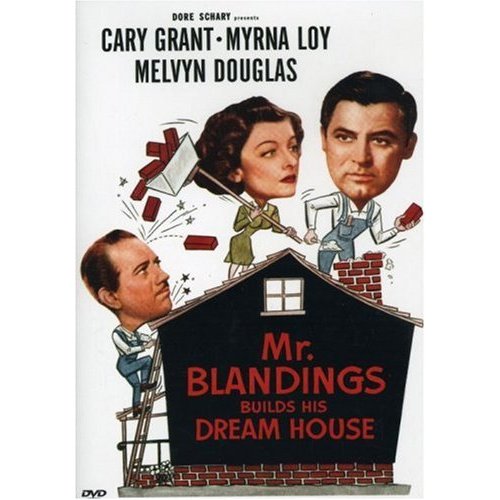
I have always been crazy about old movies. When I was growing up, my mom and I used to watch them together on Saturday afternoons. To this day I’ll stop to watch anything with Cary Grant in it. And I can never resist a story that revolves around a house! So it makes sense that Mr. Blandings Builds His Dream House would be one of my all-time favorites. I’ve watched it more times than I can count.

side-of-house-with-windows

The story starts in New York City, where the Blandings (Cary Grant and the fabulous Myrna Loy) live with their children in a small apartment:

apartment-ext

Mr. and Mrs. Blandings sleep in twin beds in the small master bedroom.

apartment-master-bedrm

apartment-master-bedrm-2

The dining room is so cramped there’s hardly room for both his daughter’s birdcage and the maid!

apartment-dining-rm

So they go looking for a bigger place in the country. Jim Blandings earns a good living as an advertising exec, we’re told–a whopping $15,000 a year! I ran across an old review of the film from when it came out in 1948 that said:

“It’s hard to feel sorry for a man trying to make ends meet on $15,000 a year when most people earn considerably less.”

This is the first place they see, known to the locals as the old Hackett place:

original-house-on-property

The real estate agent knows a couple of suckers when he sees them. He tells them a story about how the house is an historical landmark because General Gates stopped to water his horses here during the Revolutionary War.

This is how Mrs. Blandings imagines fixing it up:

how-mrs-b-imagines-it

And how Mr. Blandings envisions it:

how-mr-b-imagines-it

Their imaginations are so good that they buy the old Hackett place, only to discover that it’s a tear-down. It can’t be saved. (And that’s only the beginning of their troubles!)

They decide to build on the land instead, but the plans from the architect end up being much more than expected. The new house, he says, will cost $12,500 to build. Jim and Muriel are in shock. How could it possibly cost that much? They already spent $13,000 just on the lot and tearing down the old house.

The architect shows them the rendering of how it will look when it’s finished and the music swells. The Blandings decide to bite the bullet and build it despite the soaring costs.

architects-drawing-of-house

A real house was built for the film. According to CaryGrant.net:

In 1948, RKO Studios needed a rural setting in which to film exteriors for their comedy “Mr. Blandings Builds His Dream House.” Their neighboring studio, 20th Century Fox, had 2,000 acres of dramatic landscape in the Malibu hills that served as their location ranch, so a deal was made and construction began.

construction-begins

Despite all of the problems, the headaches, the mixups, and the soaring costs, the house is finished and moving day finally arrives:

moving-day-exterior

Jim carries Muriel over the threshold:

over-the-threshold

And right across the wet varnish on the hardwood floors.

wet varnish

“Oh, Daddy! Look at this!”

side-of-house-no-windows

The windows on the side of the house aren’t in yet! It’s gonna be a chilly night in the new house. . .

new-master-first-night

One of my favorite scenes is when Mrs. Blandings gives instructions to the painter on moving day, patiently explaining:

“First, the living room. I want it to be a soft green. Not as blue-green as a robin’s egg, but not as yellow-green as daffodils. Now, the dining room. Not just yellow–something bright and sunshiny. If you send one of your workers to the grocer for a pound of butter and match that, they can’t go wrong.” Etc, etc., with detailed descriptions of each room’s color.

As soon as she leaves the room, the painter turns to the guy next to him and asks, “Got that, Charlie?”

“Uh-huh,” he says. “Red, green, yellow, blue, and white.”

front-door-foyer

front-door

inside-the-front-door

stairs

We get a glimpse of the dining room, but we never see the kitchen:

dining room

The living room:

mrs-b-and-bill-cole-fire

living room

living rm 2

Just as Jim is about to give up on ever coming up with a promotional strategy for WHAM (it’s a Whale of a Ham!), his housekeeper Gussie (Louise Beavers, who also played Mamie in Holiday Inn with Bing Crosby–another favorite of mine!) saves the day. When Jim asks for HAM for breakfast instead of WHAM, Gussie says:

wham

So he keeps his job, he keeps his house, and everybody’s happy.

side of house-garden

In the final scene we see him holding the book he has published about his adventures in house building:

cary-grant-holds-book

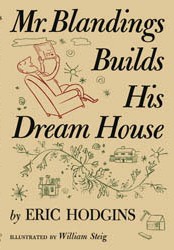
Here’s the real book, written by the real Mr. Blandings–Eric Hodgins. He based the story on his own trials and tribulations with a house he built. The actual house built by Hodgins still stands in the town of New Milford, Connecticut. It sold in August 2004 for $1.2 million.

According to an article in the Washington Post, Hodgins and his wife began construction in the classic New England small town in 1939, anticipating a budget of $11,000. It ultimately cost$56,000 to finish and nearly drove him into bankruptcy.

After living in their dream house for only 2 years, they were forced to sell and downsize. (Isn’t that sad?)

eric-hodgins-photo

Mr. Blandings Builds His Dream House, Hodgins said, “wrote itself.” It was published in 1946 and was immediately a bestseller. He made $200,000 on the movie rights alone, and the film was a hit. Hodgins wrote a sequel called Blandings Way, published in 1950.

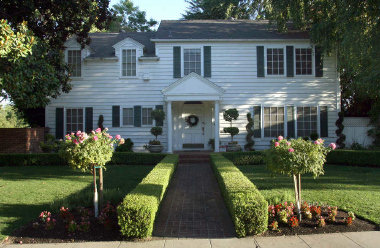
As a promotion for the film, 73 full-scale replicas of the house were built in various locations in the US and raffled off. Here’s one such house in Fresno, California (via theProvidence Journal), as it looks today.

Patricia Shackelford (aka Mrs. Blandings, who named her popular blog after Myrna Loy’s character in the movie) wrote an interesting post about it and the movie promotions here.

The house from the film is still standing. In 1974, Fox sold the ranch to the state of California. The land is now part of Malibu Creek State Park, and the house is used for the administrative offices for park employees. Here’s how it looks today:

realblandingshouse2009-malibu-carygrantdotnet

But maybe it’s best to remember it as it was. . .

blandings-dream-house-exterior

Visit the TV/Movies page for links to all of the ones I’ve featured so far, fromThe Mary Tyler Moore Show to Marley & Me.

Blog Widget by LinkWithin
Related Posts Plugin for WordPress, Blogger...

My Blog List

Contact US

celebrityhomeforsale@gmail.com

Share